Productivity template
The 1-3-5 Rule: Free Template and How to Use It
Nine tasks a day, sorted by size before the day starts. Free printable daily and weekly templates, an example day, a lighter version for ADHD days, and how it compares with the Ivy Lee method.
Published Updated
Most to-do lists fail in one of two ways: too many items, or items of wildly different sizes mixed together. The 1-3-5 rule fixes both at once. It caps the list, and it makes you decide which single task deserves the best part of your day.
What counts as big, medium and small
| Size | How many | Rough time | Examples |
|---|---|---|---|
| Big | 1 | 2 to 3 hours | Write the proposal draft, study one chapter, do the tax return |
| Medium | 3 | 30 to 60 minutes each | Prepare a meeting, a long email reply, a grocery run |
| Small | 5 | 5 to 15 minutes each | Book a haircut, pay a bill, reply to one message |
Together that is roughly a full working day. If your days are full of meetings, shrink it: a 1-2-3 day is still a 1-3-5 day in spirit.
Free 1-3-5 rule templates (PDF)
The daily sheet gives the big task its own box, with a line for the first step and a line for what "done" means. The weekly sheet puts Monday to Friday side by side, each with one big, three medium and five small lines, so you can spread the big tasks across the week.
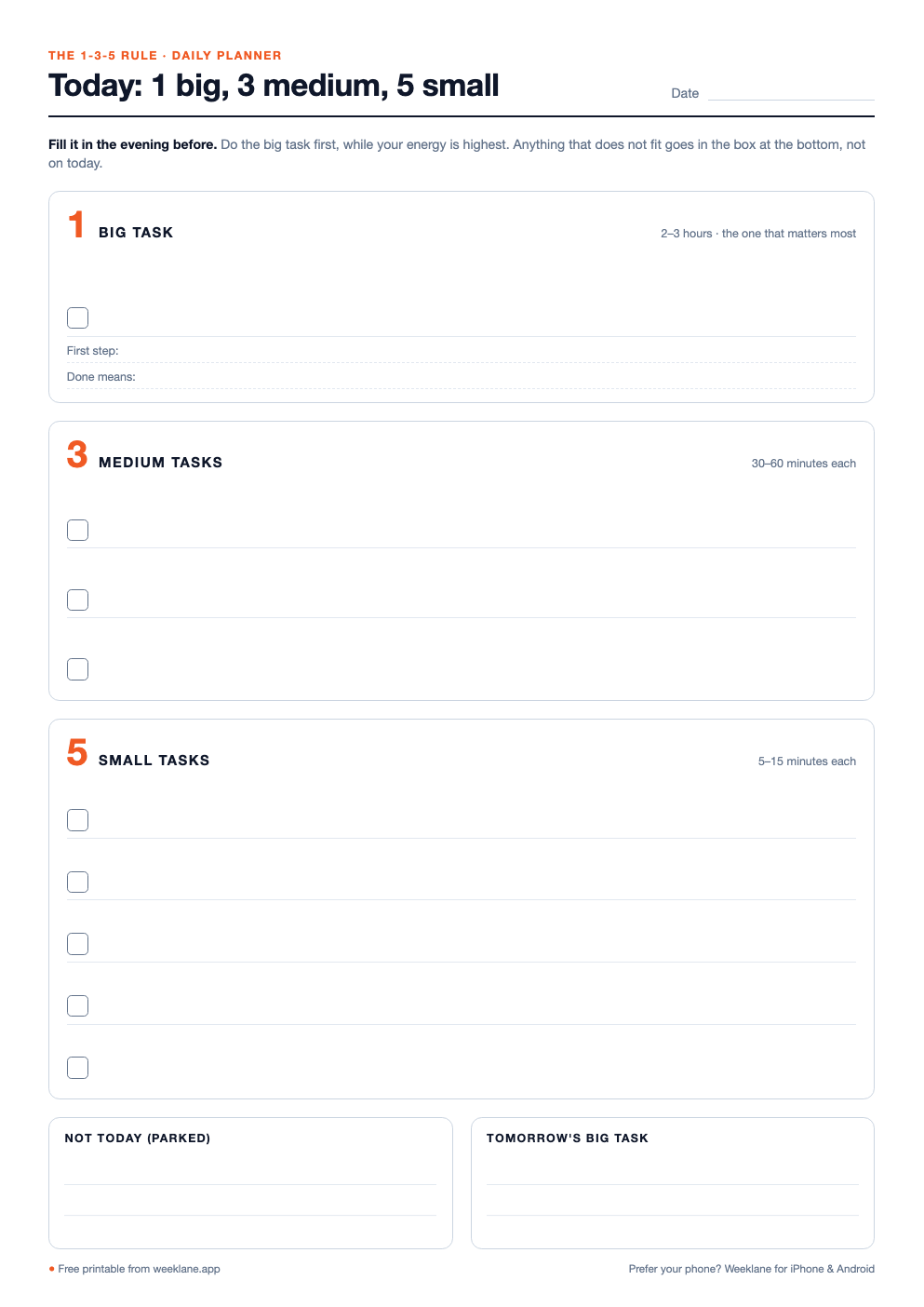
1-3-5 rule daily template
One page per day: one big task with a "first step" and "done means" line, three medium and five small tasks with checkboxes, and boxes for parked tasks and tomorrow's big task.
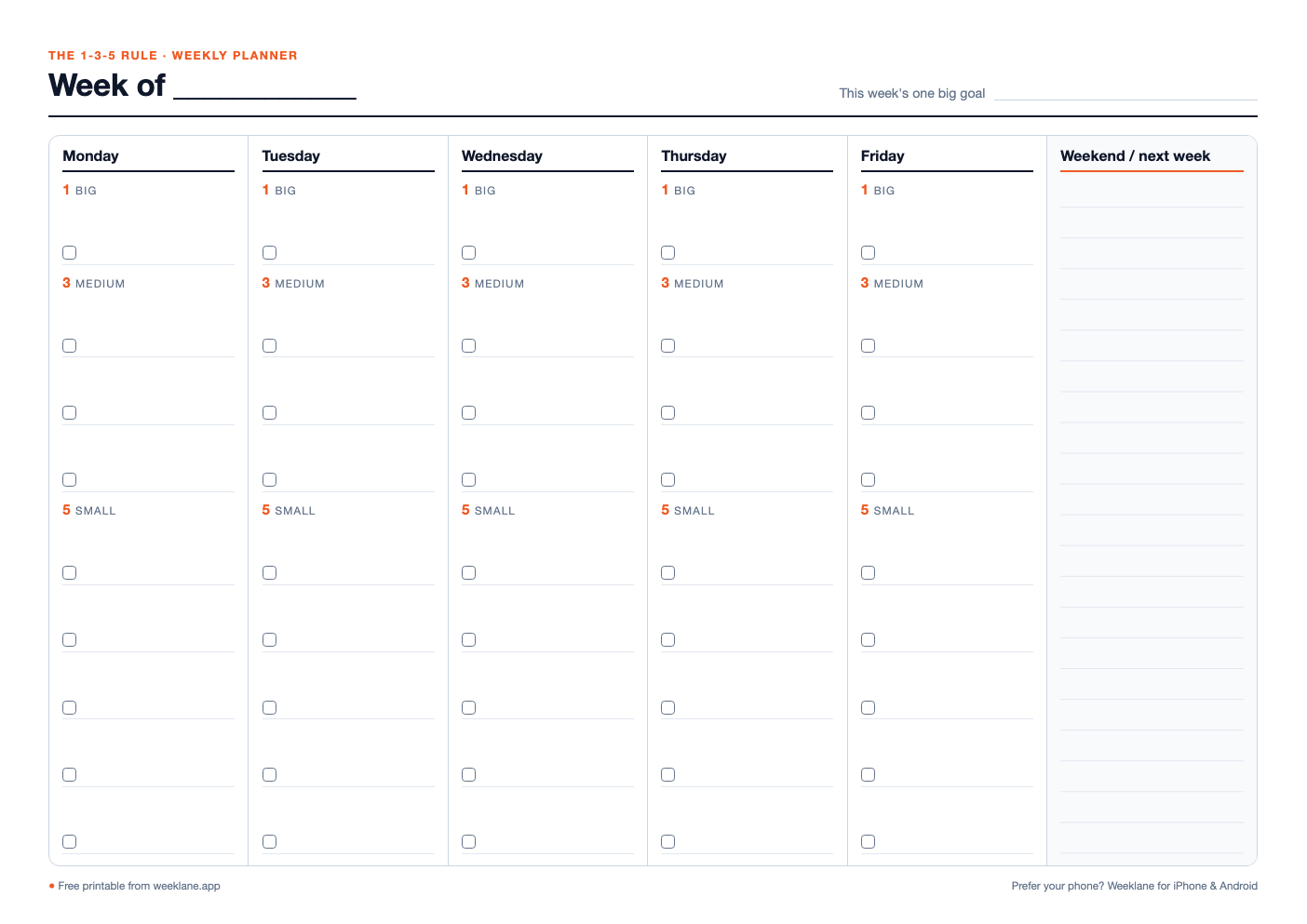
1-3-5 rule weekly template
Monday to Friday columns with 1 big, 3 medium and 5 small task lines per day, the week's one big goal, and a weekend / next week column. Landscape.
How to use the 1-3-5 rule
- Write everything down first. Empty your head onto a scrap list. Do not sort yet.
- Pick the one big task. Ask: if only one thing gets done tomorrow, which one makes the day a success? That is the big one.
- Pick three medium and five small tasks. Choose by size, not by order of importance. Everything else goes in the parked box, not on today.
- Do the big task first. Start it while your energy is highest, before email and messages. Write its first step so starting is easy.
- Review in the evening. Tick what is done, move what is not, and write tomorrow's big task while today is still fresh.
Example 1-3-5 day
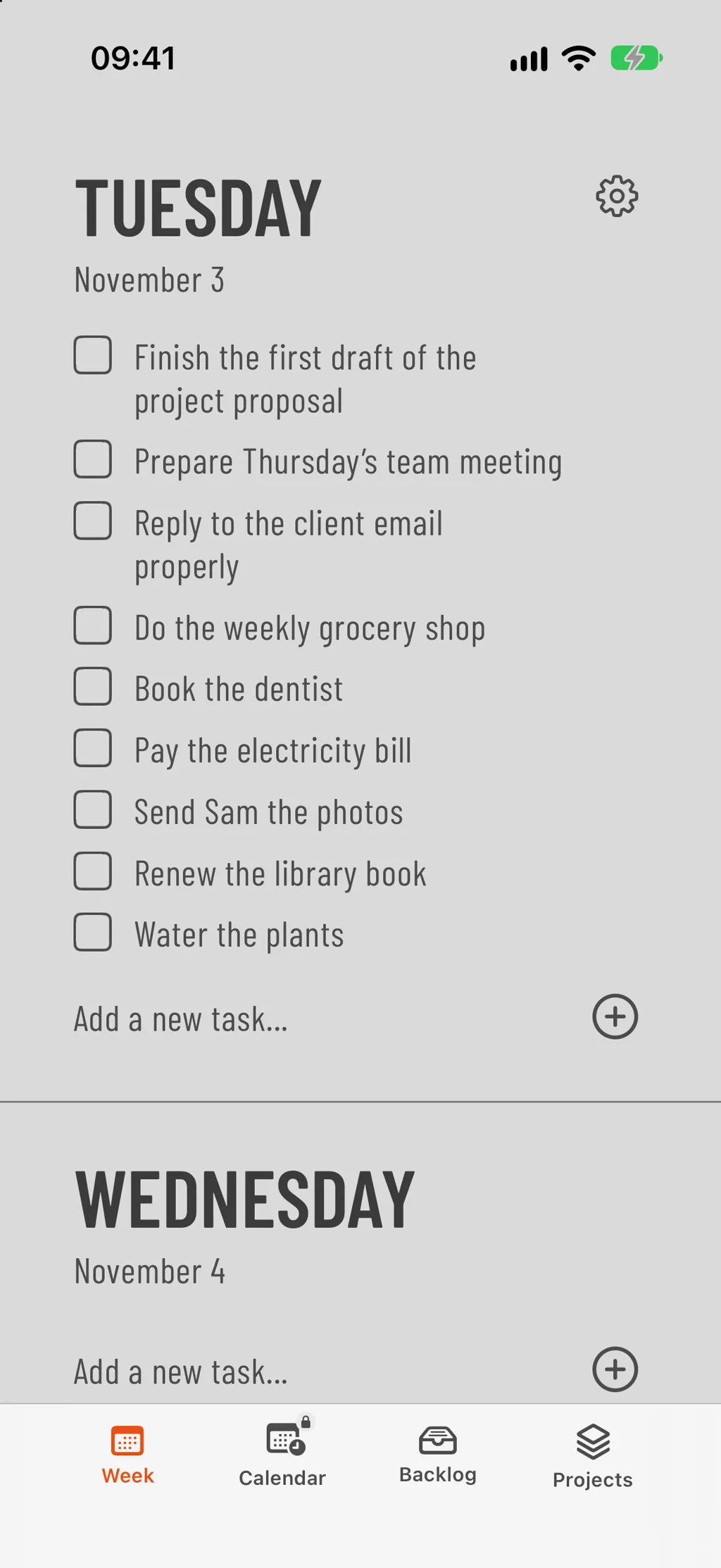
- 1 big: Finish the first draft of the project proposal.
- 3 medium: Prepare Thursday's team meeting; reply to the client email properly; do the weekly grocery shop.
- 5 small: Book the dentist; pay the electricity bill; send Sam the photos; renew the library book; water the plants.
Notice what is missing: "check email" and "Slack". Ongoing activities are not tasks. Leave them off, or they take every slot.
The ADHD tweak: make it smaller and more concrete
Many people with ADHD like the 1-3-5 rule because it limits choice. A few changes make it work better on hard days:
- Shrink to 1-2-3 when needed. A smaller list you finish beats a full one you abandon. The big task stays; the rest shrinks.
- Write the first physical step. Not "proposal" but "open the doc and write three headings". Starting is usually the hard part.
- Double your time guesses. If the big task "should take two hours", plan for four and be pleasantly surprised.
- Use one small task as a warm-up. If the big task will not start, do one five-minute task to get moving, then go straight to the big one.
For a full weekly routine built around these ideas, see the ADHD weekly planner guide. This is planning advice, not medical advice.
1-3-5 rule vs the Ivy Lee method
| 1-3-5 rule | Ivy Lee method | |
|---|---|---|
| Tasks per day | Up to 9 | Up to 6 |
| How you choose | By size: 1 big, 3 medium, 5 small | By importance, ranked 1 to 6 |
| Order of work | Big task first, the rest flexibly | Strictly top-down, finish #1 before #2 |
| Best for | Days with a mix of deep work and errands | Days where focus on a few key tasks matters most |
They combine well: rank the three medium tasks the Ivy Lee way, or use Ivy Lee on work days and 1-3-5 on days full of small errands. The Ivy Lee method guide has its own printable sheet.
Using the 1-3-5 rule in an app
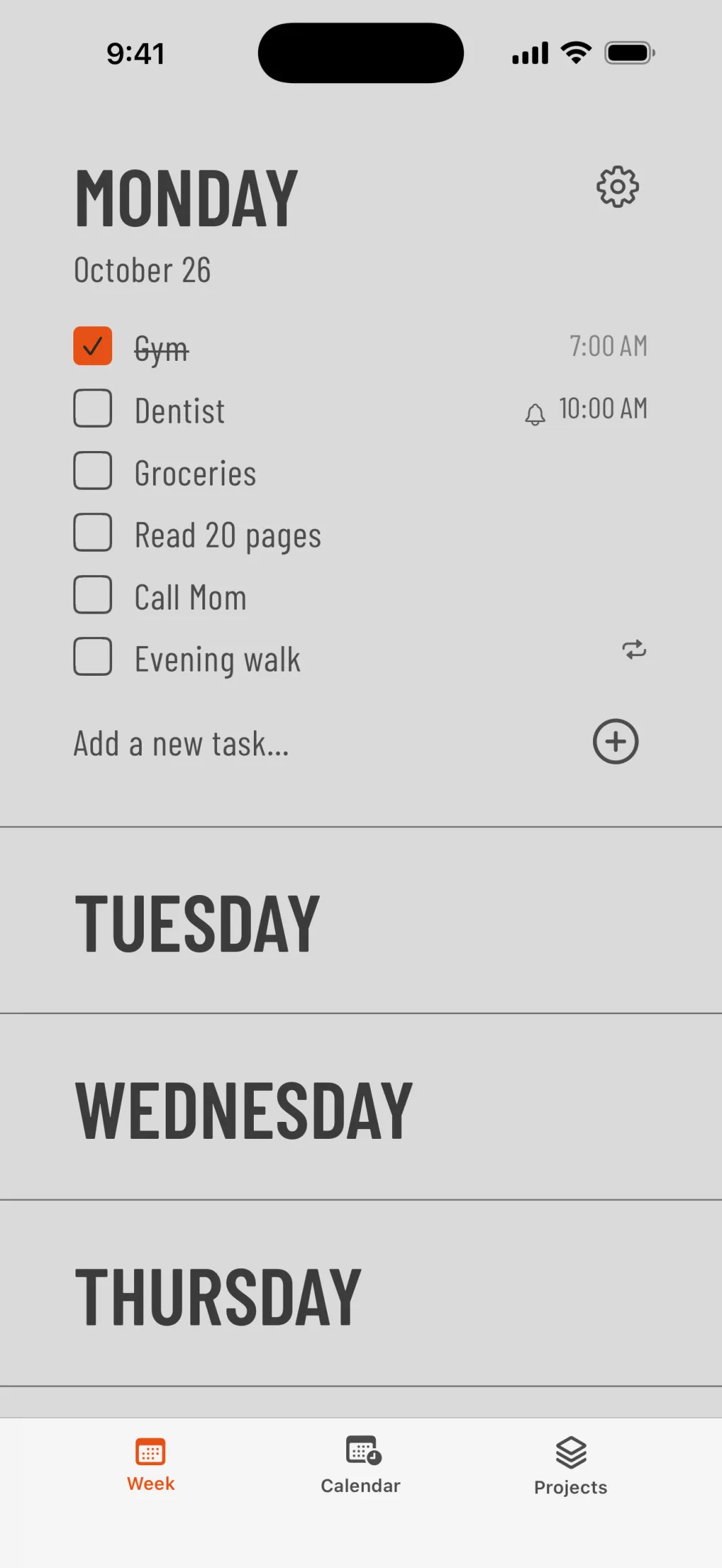
In Weeklane, each day of the week is its own short list, and nine tasks fit comfortably in one weekday. Put the big task at the top, then the three medium ones, then the five small ones, and drag to reorder. The Home Screen widget shows the top of today's list, so the big task is the first thing you see. There is also a setting that moves unfinished tasks to today, so yesterday's leftovers do not disappear; re-sort them into your 1, 3 and 5 before you start.
Frequently asked questions
What is the 1-3-5 rule?
A daily planning rule: plan one big task, three medium tasks and five small tasks for the day, nine at most. You choose the tasks by size before the day starts and do the big one first.
Is nine tasks a day too many?
Not if they are sized honestly: the five small ones take 5 to 15 minutes each. If your day has lots of meetings, use a smaller version such as 1-2-3, and keep the big task.
What if I don't finish the big task?
Move it to tomorrow and make it the big task again, but look at it first. If it keeps rolling over, it is too big: split it into a smaller big task and a medium one, and write the first physical step.
Can I use the 1-3-5 rule for a whole week?
Yes. Plan one big task per weekday, so five big tasks a week, and fill the medium and small slots the evening before each day. The free weekly 1-3-5 template has Monday to Friday columns for exactly that.
Does the 1-3-5 rule work with ADHD?
Many people with ADHD find the cap on choices helps. Shrink it to 1-2-3 on hard days, write the first physical step of the big task, and double your time estimates. It is a planning method, not a treatment.
Is the 1-3-5 template free?
Yes. Both the daily and the weekly 1-3-5 templates are free PDFs in A4 and US Letter, with no email or sign-up.
Run 1-3-5 on your phone
Weeklane shows each day as a short list on iPhone, iPad, Mac and Android, with Home Screen widgets. The weekly planner is free; Weeklane Pro has a 7-day free trial.
Scan to download
Related guides
- Ivy Lee Method: The 6-Task Daily Productivity System — six ranked tasks a day, with its own printable sheet.
- Free Time Blocking Templates: Daily & Weekly (PDF) — give the big task a fixed slot with a printable time grid.
- ADHD Planner: A Simple Weekly Planner That Actually Works — a weekly routine built for ADHD brains.
- Weekly Work Plan: Free Template and the Best Apps to Run It — decide which day each big task lands on.
- To-Do List Widget for iPhone: Home Screen and Lock Screen Setup — keep today's nine tasks on the Home Screen.
- Guides